This is a charitable read, but I think that being able to pick from a panoply of models will actually yield much better results in the long run.
The same model that has been post-trained to operate for hours as a Linux admin will be incapable of writing a heartfelt email, but with something like Fugu, you'd get both the Linux admin for driving the browser harness and the smaller writing specialist model for drafting the email itself.
Yeah, I was trying to parse their "defense policy"
https://sakana.ai/company-info/defense-policy.html?lang=en
But it seems like lot of words to say we have no policy and we'll just go along with the powers that be. Like they rely on deferring to the Pacifist constitution, which the current administration if moving mountains to try and change. And when it it you can bet they will not want to give up their defense contracts.
I was just stating facts about Sakana, and that was enough to trigger you? For the same reason, I don’t use GPT either. At least for now, DeepSeek has no ties to the defense sector. And don’t talk as if the CCP were the devil. The U.S. president is the world’s biggest arms dealer, after all.
maybe you are not bottlnecked by coding. but there is high probability that you will be bottlenecked by verifying the correctness of LLM-generated code.
Crazy how this doesn't register in people's heads. Has the real bottleneck ever been code written and not the review of code and everything involved? Understanding the nuance and implications behind design decisions; strategy.
In any REAL, workload, with good processes, code review makes speed of code generated a moot point. You still move as fast as you can review the code, and no, I won't debate that you can rely on LLMs, a deterministic language predictor, to determine the correctness of code; in the context of the business, and technical implications.
If you are a responsible maintainer you need to verify the correctness of the contribution wether you used an LLM to generate it or wether someone else did.
Having someone else be the AI-middlemen, just introduces additional complexity and confusion.
It's interesting that they mentioned in the release notes:
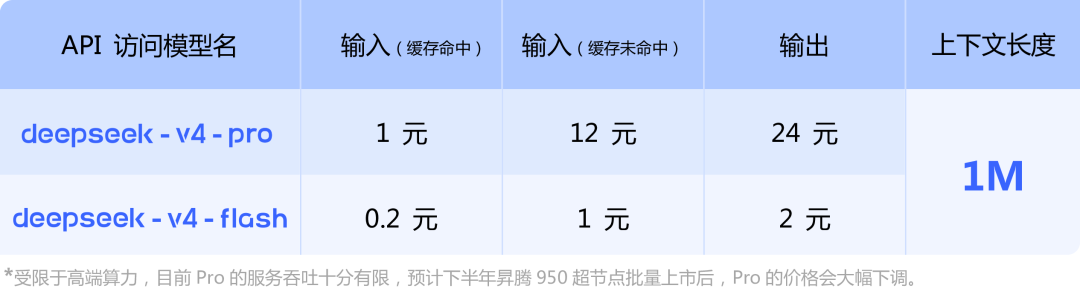
"Limited by the capacity of high-end computational resources, the current throughput of the Pro model remains constrained. We expect its pricing to decrease significantly once the Ascend 950 has been deployed into production."
It feels like the current trend is a bit scary: the more AI advances, the more people with money and resources will gain disproportionately greater advantages. For example, they can make their own software more secure, while also finding it easier to discover ways to attack other software.
You can already do that today by hiring a security researcher. I can guarantee you that Apple has access to people of a higher caliber than my startup.
I could see a world where 1 year from now I can have glassing do a full sweep of my codebase for a given price (say: $10k). Running that once a year is within my means and would make my software much more secure than it is today.
Yeah but even Carlini who is a good security researcher said he has found more valid vulnerabilities in the last week than his entire career before this. That sounds like it’s clearly better/faster/cheaper than a human security researcher that would cost $300,000 a year.
I spend well over that of my employers money on pentesting every year. I’m absolutely certain Claude could perform as good or better a job using what’s available today.
It had crossed my mind that an AI agent pentester would be an interesting product to build. Once again though, the labs are just going to build it because it’s a thin thin wrapper.
Beyond existing software with vulnerabilities, the really important aspect of this for Anthropic et al is that the gigatons of code that are being generated every day needs to be secured.
There are quite a few such startups already out there. Results are mixed so far. Though I believe they get much better over the coming months and years.
i.e. it may be a step change and that could very well have distinct and noticeable real world effects, like other technologies have in the past, but it’s nothing fundamentally new.
My impression is that, before Microsoft acquired GitHub, GitHub went for many years without really introducing new features, so part of its stability came from the fact that it wasn’t very ambitious or proactive about improving.
This tells us that we should never share sensitive information with GPT, even if you’ve set it not to use your data for training. Nothing can stop OpenAI from misusing your data.